
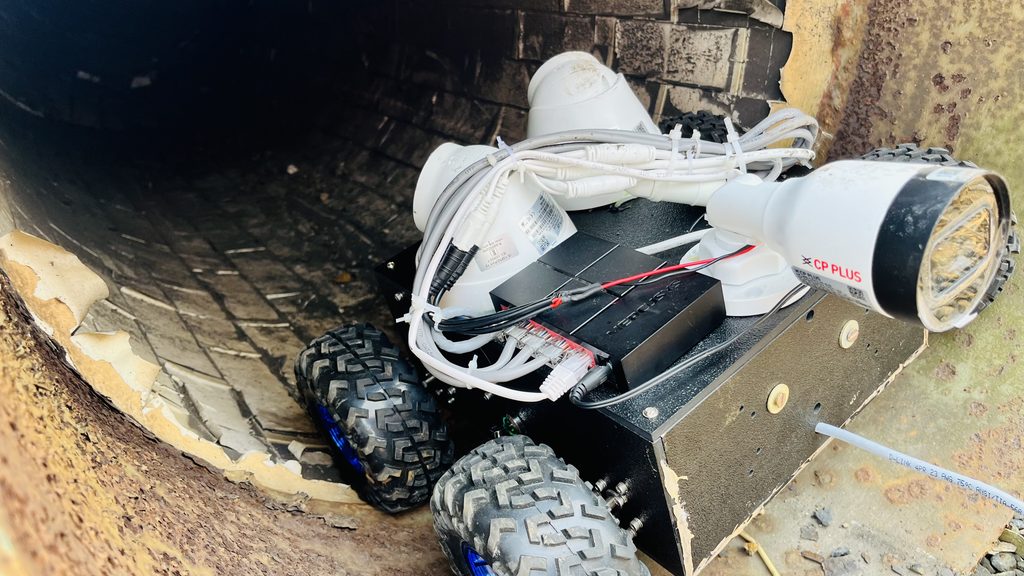
TW INSTRUMENTS developed a rugged tethered robotic survey vehicle for inspecting large industrial pipelines and other confined spaces. The system combines four-wheel skid-steer mobility, three onboard IP cameras, Ethernet-based teleoperation, embedded motor control, battery management and a custom operator interface. The tethered architecture was selected to provide reliable low-latency control and high-bandwidth video transmission inside metallic pipelines where wireless links can be heavily attenuated
A tethered four-wheel robotic inspection platform developed for surveying industrial pipelines using three onboard IP cameras, Ethernet-based teleoperation, skid-steer mobility and real-time battery telemetry.
The Engineering Challenge
Industrial pipeline inspection presents a difficult combination of constrained access, poor visibility, rugged mechanical conditions and unreliable wireless propagation. Metallic pipe structures can significantly attenuate radio signals, making a wireless-only solution less dependable for simultaneous control and multi-camera video. The rover therefore uses a tethered Ethernet architecture to provide deterministic control and direct access to multiple IP camera streams
- Confined-space access
- Multi-camera visibility
- Reliable low-latency control
- High-bandwidth video transport
- Tether drag and traction
- Battery-powered operation
- Safe high-current power distribution
Field evaluation of the inspection rover inside a large-diameter industrial pipeline (Right)
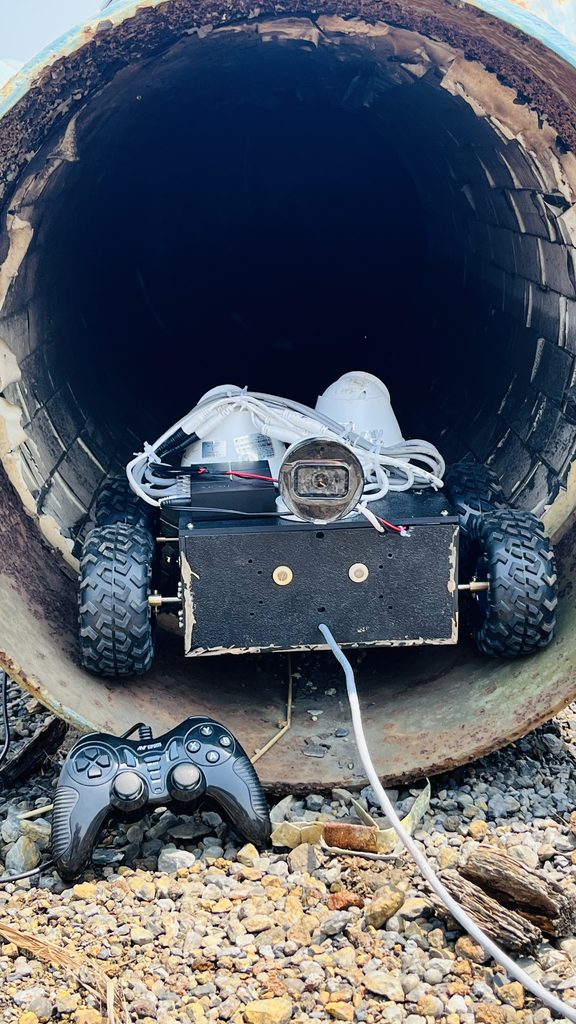
Four-wheel skid-steer rover platform with onboard vision and control hardware:
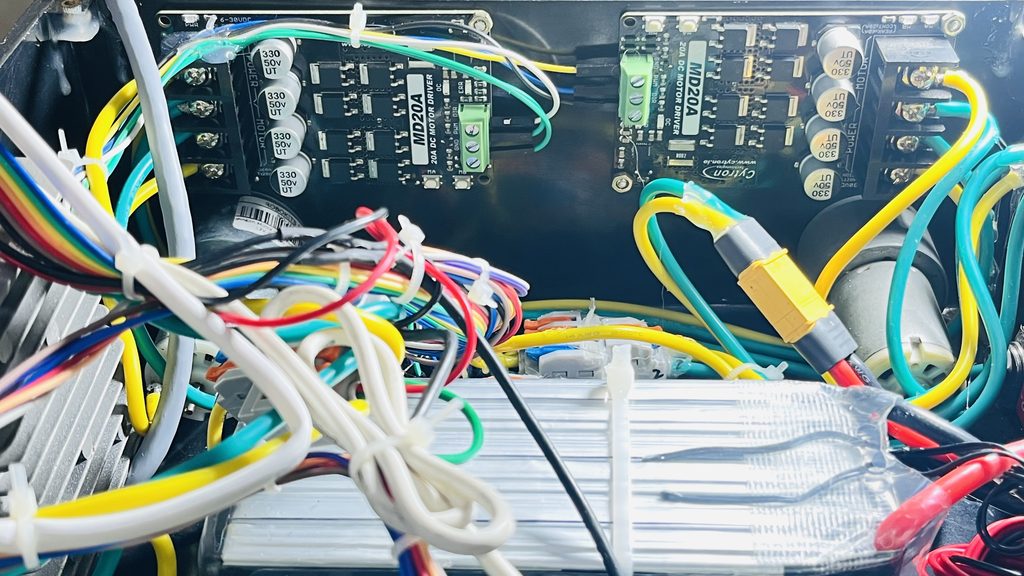
The rover uses a custom chassis fabricated from laser-cut ABS plastic. ABS was selected for its impact resistance, durability and relatively low weight, helping reduce propulsion load while maintaining adequate mechanical strength. The vehicle uses a four-wheel skid-steer drivetrain, with direction controlled by varying the relative speed of the left and right wheel sets. Propulsion is provided by four 12 V, 200 RPM high-torque DC geared motors. High-quality motor drives from Cytron were used to deliver a thumping power of up to 20Amps (as shown in the image below). This ascertains that even if there is a rough terrain, heavy drag or multiple bends in the pipeline or constricted path, there would be near zero stalling issues.
Multi-Camera Vision System:
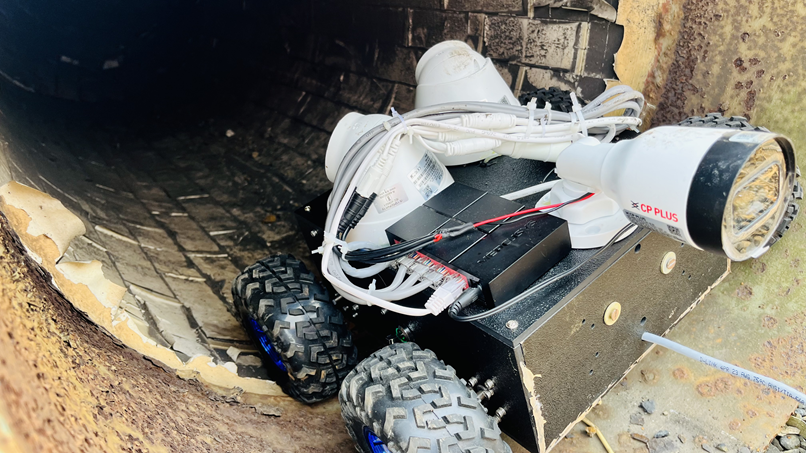
The rover carries three CP Plus network cameras connected to an onboard Ethernet network. The operator PC can access each camera directly through its IP address while simultaneously communicating with the embedded controller (from TI). This arrangement provides multiple viewing angles for inspection of internal pipe surfaces, joints, obstacles and surrounding areas that may not be visible from a single forward-facing camera. The cameras can be customized as per customer’s need. Existing cameras also can be integrated with customized engineering solutions. Talk to us for such requirements.
Embedded & Network Architecture
The central embedded controller is the Texas Instruments MSP-EXP432E401Y LaunchPad. It receives high-level commands over Ethernet and converts them into hardware-level motor-control outputs. An onboard TP-Link TL-SF1005D 5-port Ethernet switch connects Camera 1, Camera 2, Camera 3, the MSP432 controller and the tether leading back to the operator PC
- MCU: TI MSP-EXP432E401Y
- Networking: 5-port Ethernet switch
- Vision: 3 IP cameras, each upto 4K display resolution compatible (2160p
- Control Link: Ethernet tether upto 1Gbps bandwidth link
- Operator Interface: PC-based control station
- Transport: TCP/IP